Check out our latest cooking demo recipe, plus recipes from previous demos below. If you came along to see the cooking demo live, thanks for joining us! If not, you missed out on a seriously delicious day. You can catch us at more festivals throughout the year, so check back for updates, or book a spot in our cooking class for the full experience. Go behind the scenes at Prashad to learn the secrets to cooking delicious Indian food at home, and feast on fantastic Gujarati cuisine. It’s an intimate experience with just eight guests per class, and it books up quickly, so keep an eye on our socials for new dates being released.
Fresh lockdown recipe to spice up your lunchtime routine
Working from home? Our new social distancing lifestyle can take a toll on our mental health, particularly when things get so routine that you start to feel like you’re repeating the same day, over and over. Shake things up to keep it spicy!
Our #CookingThroughCovid19 short recipe blog series will help you stay inspired through your self-isolation, with delicious (and easy) home cooking cures for the lockdown blues.
We’ve got the perfect lunchtime treat for you today. It’s time to swap out the floppy sliced bread sandwiches and crisps for something extra special. Kaushy’s mashed potato and chilli sandwich (yes, you heard right!) is an indulgent Indian street food style dish with a twist.
Instead of the usual flatbreads or chapatis that play a big part in the Guajarati diet, we’ve opted for the soft white bread that’s much-loved across the nation. Enjoy this sandwich on its own to fully appreciate all the layers of flavour and different textures.
Why not switch up the scenery too and enjoy your lunch outdoors (if the British weather permits)? It’s surprising how much impact the small changes in our lifestyle can have. Keep well, keep cooking!
(Serves 4)
You will need:
50ml sunflower oil
1 tsp cumin seeds
4 medium red-skinned (or other waxy) potatoes (boiled, peeled and mashed)
½ tsp turmeric
1½ tsp medium red chilli powder
2 tsp ground coriander
2 tsp garam masala
2 tsp salt
Juice of ½ lime
12 finger bread buns (sliced in half and buttered)
1 handful fresh coriander (washed and finely chopped)
40g sev – or Indian chickpea vermicelli (optional)
melted butter (about 5g) to brush the buns
You can use your favourite plant-based butter to make this recipe vegan.
Method:
Heat the oil in a large thick-based frying pan on a high heat for 1½ minutes then add your cumin seeds. When they start to bubble, use a wooden or heatproof plastic spoon to stir in the mashed potato, ensuring it gets well coated in the cumin-infused oil.
Reduce the heat to low and add your turmeric, chilli powder, ground coriander, ground cumin, garam masala, salt and lime juice. Mix these ingredients together and cook for 2½ minutes before taking the pan off the heat.
Using a griddle pan, gently toast the buttered buns on both sides before you start to assemble your sandwich. Fill the buns with imli chutney, a generous dollop of the potato mixture and a sprinkling of ground peanuts. Garnish with chopped red onion, chopped vine tomatoes and fresh coriander.
Once assembled, close your bun and brush the top with a little butter (optional: and sprinkle with sev) before tucking right in!
Share your creations to win
We’d love to see your scrumptious sandwiches! For your chance to win a £20 prize voucher for the most creatively presented sandwich, simply share your photos with us by tagging us and using #CookingThroughCovid19. Our competition judge, Kaushy, is looking forward to seeing your culinary creations.
Life in lockdown can be tough, but good food will see you through. Prashad are here to help with our new #CookingThroughCovid19 series of short recipe blogs, adapted from our award-winning cookbooks to help you get inspired in the kitchen.
And what better way to keep lockdown blues at bay than a scrumptious stack of pancakes? Treat the kids to a fun family pancake making session – with a twist! Kaushy’s healthy mixed vegetable pancakes are super easy to prepare and packed full of flavour, so even the littlest hands can get involved. With this adaptable recipe, you can get creative and throw in some of your own favourite veggies (add a little sweetcorn perhaps?).
(Serves 4)
You will need:
Masala
8 fresh green chillies (trimmed, not de-seeded)
4 cloves of garlic (soaked and peeled)
pinch of salt
1 medium red pepper (washed and cut)
1 medium yellow pepper (washed and cut)
1 medium green pepper (washed and cut)
2 medium red onions (peeled and cut)
2 medium vine tomatoes (washed and cut)
2 handfuls of fresh coriander (washed and finely chopped)
320g idli flour (sieved)
200ml warm water
160ml sunflower oil (for frying)
All veggies should be cut evenly in ½ cm dice.
Method:
Crush your chillies and garlic together with a pinch of salt using a pestle and mortar (or a blender) to make a fine masala paste. Only adults should do this, and you should wash your hands thoroughly after touching the chillies.
Put a quarter of the vegetables and a quarter of the fresh coriander in a large bowl with a quarter of the flour and a quarter of the masala paste. Your little helpers can get involved at this stage, mixing all these ingredients together using their clean hands. Make sure the flour is fully worked through the mixture.
Add 50ml of water and mix again, incorporating as much air as you can and gently folding the vegetables through the batter.
Adults only! Heat 10ml of sunflower oil in a small, deep frying pan on a medium heat for one minute. Then put the uttapam batter in the pan and gently spread it to the edges.
Cover and cook for six minutes, then gently ease it off the sides and shake the pan to loosen the bottom. Toss the pancake over (use a spatula if you’re feeling nervous) then drizzle 30ml of oil around the edge. Recover and cook for a further five minutes.
Remove the pancake from the pan and cut into quarters to share around. Then repeat three more times with the remaining batter. These pancakes are best served with sambar or kopru chutney – recipes in our Prashad at Home cookbook.
Share your creations
Share your cookery creations with us by tagging us or using #CookingThroughCovid19 for your chance to feature on our social media (go follow us on Facebook, Twitter and Instagram) – we’d love to see you and the family enjoying your uttapam pancakes!
Have you discovered a love for plant-based foods this Veganuary? Over 500,000 people from 178 countries around the world have participated in Veganuary since 2014, and the numbers keep going up.
At Prashad, we’re proud to have been far ahead of the vegan boom, serving a collection of mouth-watering vegetarian and vegan dishes inspired by traditional Gujarati cuisine since we began all those years ago.
If you’re looking to keep up your vegan efforts through February and beyond, we’ve got a few suggestions for bringing the flavours of Gujarat into your own home with our tried, tested and much-loved low-calorie vegan recipes!
Hungry for more? Our cookbooks are absolutely packed with veggie/vegan dishes – some are fantastic healthy options, while others are far more indulgent…
For starters: Bafela Patra
A popular choice from our days as a deli, our bafela patra always had customers coming back for more.
A delicious mix of spices wrapped in colocasia leaves, patra is traditionally served at parties or family gatherings, but in recent years we’ve seen people start to use it as a healthy, vegan addition to a cooked breakfast.
This recipe is vegan, free from nuts and can serve up to four people.
Notes from Minal: If you want to be extra healthy, I’d recommend being a little more conservative on the salt and to consider using olive oil instead.
To create the masala, you will need:
8 medium patra (colocasia) leaves
2-4 fresh green chillies (trimmed but not de-seeded)
2-4 cloves of garlic
3cm piece of root ginger (peeled and roughly chopped)
1 pinch of salt
To create the paste, you will need:
50g dried tamarind (from a block
150ml boiling water
200g chickpea flour
50 chapatti rice
50g rice flour
1½tsp salt
40g jaggery (finely chopped)
1½tsp carom seeds
1½tsp turmeric
2-4tsp ground coriander
1tbsp garam masala
5tsp sesame seeds (4tsp will be used as garnish)
60ml sunflower oil
200ml warm water
Notes from Minal: If you can’t find any jaggery, I suggest using demerara or soft brown sugar.
Method:
Wash your Patra leaves and place them vein-side up on a chopping board. Using a small knife, carefully slice off the thick central vein.
Crush your chillies, garlic and ginger together with a pinch of salt with a pestle and mortar (or in a blender) to make a fine masala paste.
Soak the dried tamarind in boiling water for five minutes, then pulp with your fingers and a sieve, draining the tamarind water into a small bowl. Squeeze the pulp to get as much flavour as possible!
Sieve your flours together and mix in your masala paste, salt, jaggery, carom seeds, spices, one teaspoon of sesame seeds and your oil. Mix well to make sure all the masala is worked in.
Pour your tamarind water and warm water into the mixture and mix to form a sticky but workable paste, before leaving the mixture to rest for 10 minutes.
Take one of your larger Patra leaves and place it vein-side facing up on a chopping board or your work surface, leaf tip furthest from you. Gently spread the leaf with enough paste to cover with a 5mm layer.
Take a second leaf and lay it on top of the first, again vein-side up. Spread the surface of the new leaf with paste.
Carefully lift the sides of the leaf stack and fold about 4cm in towards the centre, keeping the sides straight.
Spread a layer of paste over the leaf sections that you have just folded in (the new top surface). Then gently lift the closest end of the Patra leaf and fold about 4cm onto itself, then fold again and continue to fold away from you until you reach the tip.
Repeat the pasting, layering, folding and rolling three more times to use up the remaining six leaves, giving you four Patra rolls.
To cook, put a flat-based heatproof bowl in a large, deep pan. Pour water into the pan until it reaches most of the way up the bowl, leaving about 2cm of the rim sticking about the water. Place your pan over a high heat.
Lightly oil a medium plate with a 2cm rim or lip that will fit in the pan (the rim will give you something to grip when you remove it from the steamer and help to prevent the Patra falling into the water).
Put the four rolls, with the seam of the rolls facing down, on the oiled plate and gently place it on top of the bowl in the pan. Put the lid on the pan, wrap the rim of the lid with a cloth or tea towel (if it is a flat lid) and put weight on the lid to secure it.
Reduce the heat to medium and then leave to steam for 35 minutes, turning the rolls after 15 minutes. To check they are fully cooked, insert a sharp knife into the middle of a roll. The knife should come out clean.
Carefully remove the plate from the steamer and leave to cool for five minutes. Put the Patra on a chopping board and use a sharp knife to slice each one into four even slices.
Drizzle with a little sunflower oil (optional), sprinkle with sesame seeds to garnish and serve warm – ideally with Kopru dip and a cup of hot Adhu Vari Chai (see our cookbook).
For the main: Wattana and Flower
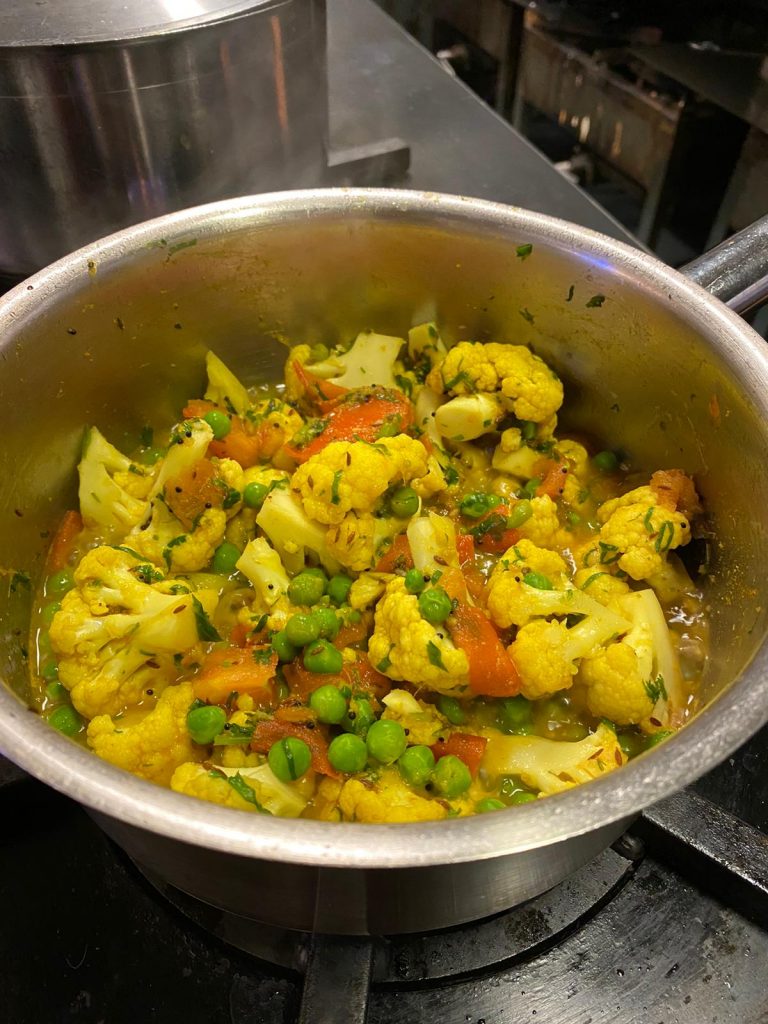
Wattana and flower is a Prashad family favourite. This pea and cauliflower curry appeared on Prashad’s very first restaurant menu, and seven years on, it’s still a favourite among our customers.
This recipe is vegan, free from wheat, nuts, onion and garlic, and can serve up to four people.
You will need:
3-6 fresh green chillies (trimmed but not deseeded)
5cm piece of root ginger (peeled and roughly chopped)
1 pinch of salt
100ml sunflower oil
1tsp cumin seeds
1tsp brown mustard seeds
1/2 tsp asafoetida
1 medium cauliflower (cut into 1cm pieces)
1tbsp turmeric
1tbsp ground coriander
1½tsp of salt
1tbsp sugar
75ml boiling water (if using fresh peas)
400g peas (fresh or frozen)
1 medium tomato (finely chopped)
1 large handful fresh coriander (roughly chopped)
Notes from Minal: If you’re using frozen peas, I recommend using petits pois – they are smaller and sweeter than ordinary garden peas and really enhance the dish.
Method:
Crush your chillies and ginger together with pinch of salt with pestle and mortar (or in a blender) to make a fine masala paste.
Heat the oil in a large, thick-based frying pan over a medium heat for 30 seconds before adding the cumin and mustard seeds.
When the mustard seeds begin to pop, reduce the heat to low and stir in the asafoetida – heating the spices in this order is essential to the flavour.
Using a wooden (or heatproof plastic) spoon, stir in the cauliflower and return the heat to medium. Stir in the masala paste, turmeric, ground coriander, salt and sugar (and add the boiling water if you are using fresh peas).
Cover the pan and leave to cook for 8-10 minutes, stirring every few minutes.
Stir in the peas and tomato, then recover and cook for a further 3-5 minutes before removing from the heat.
Sprinkle with your chopped coriander and leave to rest for five minutes – this allows the flavours to develop.
For the accompaniment: Mung Dhal Kichdi
Mung dhal kichdi is a warming yellow lentil rice traditionally served to those feeling a little under the weather – but it can be enjoyed by all! A true comfort food, this dish is both delicious and high in protein.
This recipe is vegan, free from wheat and nuts, and can serve up to four people.
You will need:
175g mung dhal (yellow split mung beans)
175g basmati rice
75ml sunflower oil
2-4 cloves of garlic (finely chopped)
1¼tsp of salt
¼tsp turmeric
900ml boiling water
Method:
Mix the dhal and rice together, then rinse in warm water, running your fingers gently through to help clean them (and to check for small stones). Drain and repeat – two washes will remove enough starch to make the cooked rice fluffy and loose.
Heat the oil in a large pan over a medium heat for a minute. Add the dhal and rice and fry together for another minute, gently stirring to coat them in the oil.
Stir in the garlic, salt and turmeric and fry for another minute, then pour in the boiling water – it’s essential the water is boiling as it helps the rice to cook quickly and improves the texture.
Bring to the boil, then simmer uncovered over a medium heat for 10-12 minutes until almost all the water has cooked off and it starts to look dry on top.
Put a large square of aluminium foil on top of the rice and dhal, tucking it in at the edges of the pan to create a seal – keeping the rice moist and fluffy while it steams.
Cover the lid, reduce the heat to the lowest setting and leave to cook for 7-8 minutes. Then remove from the heat and set aside to rest for at least 5 minutes.
When you remove the foil, everything should be perfectly cooked. Gently run a spoon through it to loosen, taking care not to break the rice grains, then serve straight away.
Don’t forget to share your cookery creations with us on Facebook, Twitter and Instagram – we’d love to see what you’ve made. Best of luck to all of those looking to extend their vegan diets beyond Veganuary, or even those just looking to reduce their meat-eating habits with some healthy veggie dishes!
As seen on BBC Countryfile 2016, our Rhubarb Sizzler is a seasonal starter that was created to celebrate our Gujarati heritage and embrace our connections to the Yorkshire region.
Ingredients
Fresh Masala 4-5 Kenyan green chillies, trimmed but not de-seeded
5-6 Garlic cloves, soaked and peeled
Dough 250g Sorghum flour, sieved
50g gram (Chickpea) flour, sieved
600g Rhubarb, chopped and then coarsely blended
50ml sunflower oil
3tsp coriander powder
½ tsp ground cumin powder
½ tsp asafoetida
1 tsp cumin seeds
4 ½ tsp sugar
1½ tsp salt
1 handful fresh coriander, washed and finely chopped
50ml water
Last week, we recommended some of our favourite themed treats, and this week we have another one for you! This sweet, carrot pudding is the perfect shade of orange for Halloween, and is a delicious alternative to pumpkin desserts. It’s not just a Halloween dish either – because it’s such a warming pudding it’s great for family meals on Bonfire Night too.
Gajar halva – Traditional carrot and cardamom pudding (WF, OG, N)
Ramesh, the sous chef at Prashad, perfected this recipe for this classic Indian pudding with the help of Kaushy’s husband. They once cooked this moist, moreish carrot sweet for more than 1000 people at a dinner for yoga guru Baba Ramdev, on a remote Scottish island. When Baba Ramdev came to compliment the chef and extend his blessings, Mohan’s smile was enormous, despite twenty-four hours in the kitchens! The milk powder helps to thicken the dish and absorb any excess moisture from the carrots. Any leftover gajar halva will keep in an airtight container in the fridge for a couple of days – reheat it over a low heat or in the microwave or simply enjoy it cold – it’s delicious.
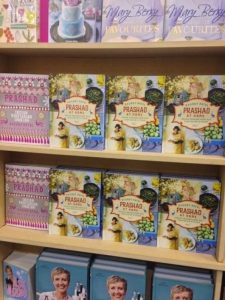
Monday, 21st September, 2015 We’re delighted to see ‘Prashad at Home’ on the shelves. This is our second cookery book, and quite different to our first with new recipe styles and beautiful imagery of India throughout.
August and September has seen Kaushy (author and mum) busy signing books, and to see the book on the shelves at Waterstone’s was especially pleasing!
You can also buy the book at plenty of other stores in addition to our own website.
We have so many exciting development happening here at Prashad and we can’t wait to share them with you. After the great success of Kaushy’s first cookbook, we’ve been busy picking out our favourite family recipes to include in a second cookbook. Containing a selection of dishes that Kaushy cooks for the family, the book will be released on 27th August, weve already unveiled the fab front cover and more details will be announced soon (with a few sneaky peeks for all of our eager friends!)
As well as the exciting adventures behind the scenes at Prashad, many of our regular diners will have noticed a change in our restaurant. The launch of a new menu! Don’t worry, we’ve kept lots of the favourites in there but we’ve also added a few new dishes that Minal is sure you will love.
One of the newbies is a Mushroom Palak dish, this spinach and mushroom curry is a delicious meal and is one of our simpler dishes from the first cookbook, if you want to have a go yourself.
It’s Meat Free Week! We love to spread the word and challenge carnivores to eat veggie for a whole week, what sounds like a tough task often turns out to be the catalyst for fun in the kitchen! Obviously, if the contender is well equipped with yummy recipes (such recipes can be found in our cookbook) they soon begin to realise that going meat-free doesn’t mean taste-free!
This week, we’ve decided to offer a little incentive to anyone taking part in the Meat-Free challenge, all you have to do is dine with us during the week 23rd-29th March and get a free Special Chaat on us! Book online here (Simply quote MFW-2015 to a member of our team)
If you need a bit of veggie recipe inspiration, check out the Dai Vada dish we’ve shared below, we promise it’s so scrumptious you won’t miss the meat!
As the world has just celebrated International Women’s Day and with Mother’s Day approaching this weekend, we thought we would ask the important female figures at Prashad, Head Chef Minal and Founder Kaushy, about how their strong and supportive mum’s have influenced their success.
Minal “I’ve always been heavily influenced by my mum, she’s been my number one supporter since I first stood in the kitchen and shares my ambition to be one of the UK’s leading veggie chefs. She taught me the basics of cooking and I still put into practice her cooking techniques every day.”
Kaushy “Anyone who has the Prashad cookbook will already know about my amazing grandmother and the influence she had on me growing up with her in Pardi, India. She was the most generous person I have ever known and her ‘cooking with love’ ethos is something I try to reflect everyday whether cooking for my family or for our lovely customers in the restaurant.”
In preparation for the big ‘M’ day we thought we’d share one of our all-time favourite family curry recipes that sets the tone for a great feast.